.png)
.png)
The Tabernacle – Part 2

Life Lessons of Forgiveness, Cleansing & Covenant
A deeper look at Pastor John Powell’s teaching on the Laver and the Table of the Lord.
This blog is based on Episode 3 of the YouTube teaching The Tabernacle by Church on the Move. If you want the full depth of the teaching, you can watch the episode on their YouTube channel — and I encourage you to do so. What follows is a written journey through the heart of that message.
In Episode 2 of The Tabernacle, Pastor John Powell continues guiding us through the ancient pattern God gave Moses — a pattern that reveals Jesus Christ in every detail. Last time, we explored the brazen altar, the place of sacrifice, and how it foreshadows the cross. But as John reminds us, the tabernacle is a journey, not a monument. We are meant to move.

“That’s what the tabernacle was for — to journey from one place to another place… it’s all forward movement right now.”
This episode takes us deeper into the outer court, to the place of cleansing, forgiveness, and preparation — the Laver — and then into the Holy Place, where we discover the true “weapons of our warfare.”
1. We Are the Tabernacle — Body, Soul, Spirit
John begins with a foundational truth: The tabernacle is no longer a tent in the wilderness — it is us.
“We are the tabernacles, temples of the Holy Spirit… we are in three parts as well: body, soul, spirit.”
Just as the tabernacle had three sections, we are designed with three dimensions:
Body — the earthly realm
Soul — the realm of decision, emotion, and spiritual battle
Spirit — the place of union with God
And just as the priests could not rush past the altar, neither can we. The cross is our starting point — and our anchor.
“You can never move on from the cross… it’s got to be central to your world.”
But the cross is not the end of the journey. It is the doorway.
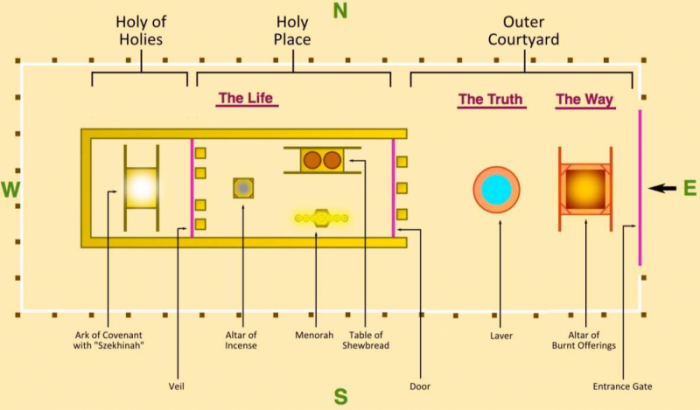
2. The Laver — The Painful, Beautiful Work of Forgiveness
After the altar came the Laver, a great bronze basin made from the polished mirrors of Egypt. It was the place where priests washed before entering the Holy Place. John explains that this is the place where many believers get stuck — because the laver represents forgiveness, both received and given.
“I’ve received the forgiveness of Jesus… but guess what? I’ve not released forgiveness.”
This is where the teaching becomes practical and personal.
The Laver Shows Us Ourselves
Because the laver was made of polished bronze (a mirror), the priest saw his own reflection as he washed. Likewise, the Word of God reveals what we cannot see on our own.
“As we gaze into the word of God, we see a reflection of ourselves.”
And sometimes, we need others to help us see what we’ve missed.
“They’d say, ‘Hey, you’ve got a bit there… that needs putting right.’”
This is not about shame — it’s about cleansing.
Forgiveness Is Not Optional
John is blunt here, and rightly so:
“We cannot keep living in perpetual unforgiveness and wonder why we are not moving on… why our prayers are not being answered.”
Forgiveness is the gateway into spiritual authority. It is also the place where the priesthood is passed down.
The Laver and Baptism
In Solomon’s Temple, the laver became so large it was called “the Sea,” and priests were fully immersed.
“One generation baptizing the next generation into the priesthood… this is where baptism starts.”
This is powerful imagery:
Cleansing
Letting go of the old life
Receiving priestly authority
John says: “If we are willing to let go of things, God is willing to bestow on us things beyond our wildest dreams.”
The laver is not a place to camp — but it is a place we must pass through.
3. Entering the Holy Place — The Realm of Spiritual Warfare
Once cleansed, the priest could enter the Holy Place, the realm of the soul — the battleground of thoughts, emotions, and spiritual resistance.
John challenges a common assumption:
“People say the weapons of our warfare are the armour of God… but that’s not the correct answer.” The armour of God contains only one piece of weaponry (the sword- the Word).
Instead, the tabernacle reveals three spiritual weapons:
Weapon 1 — The Covenant (Bread & Wine)
Weapon 2 — The Word (Lampstand)
Weapon 3 — Worship & Prayer (Altar of Incense)
These are not metaphors — they are practices.
“When you step into the spiritual realm, the things you are doing in that place are the weapons of your warfare.”
4. The Table of Showbread — The Lord’s Own Altar
The first stop in the Holy Place is the Table of Showbread — the table of the Lord.
John calls this “the forgotten weapon.”
Communion Is Not a Ritual — It Is Warfare
“If you don’t break bread, you’re not using one of the weapons of warfare.”
The table is where God Himself serves us.
“It’s the altar of the Lord… an altar that He serves at.”
And in this place, the enemy is silenced.
“Sit down there and shut up and watch what I’m about to do.”
The Bread — Wholeness, Provision, Healing
The bread was made of the finest flour — not ordinary flour.
“Every time we participate, this is something special… the bread that came down from heaven.”
Jesus said, “This is my body.” John explains:
You are receiving wholeness
You are receiving provision
You are receiving strength
You are receiving identity
“How can you be whole if you’re not provided for?”
The Cup — The New Covenant Poured Out
In the tabernacle, the wine was poured out as an offering.
Jesus transformed that symbol: “Take, drink all of it… you are ratifying the covenant.”
Communion is not a memorial — it is a moment of activation.
5. Bringing the Table Into Your Home
One of the most practical teachings in this episode is John’s encouragement to bring communion into everyday life.
“When things go wrong at home… the best thing you can do is go to the kitchen, get some bread and wine… and bring it to the Lord.”
Stepping into communion in moments of fear, panic, or chaos is like crossing a threshold. You leave the noise of the natural realm and enter the stillness of the spiritual, where covenant speaks louder than circumstance. I can say from experience that this isn’t theory — it works. Time and again, my family and I have felt “the peace that surpasses all understanding” settle over a situation, no matter how turbulent it looked. It brings Jesus right into the centre of the moment, and you become aware that He is walking through the storm beside you.
This is exactly what David describes in Psalm 23:2–4:
“He lets me lie down in green pastures; He leads me beside the still and quiet waters. He refreshes and restores my soul (life);He leads me in the paths of righteousness for His name’s sake. Even though I walk through the [sunless] valley of the shadow of death, I fear no evil, for You are with me; Your rod [to protect] and Your staff [to guide], they comfort and console me.”
When a shepherd walks with his sheep, he normally leads from the front. But when the path narrows or danger presses in, he moves among them — closer, more present, more protective. That is what Jesus does for us. In the tight places, He doesn’t stand at a distance calling instructions. He steps in, surrounds us, and walks with us through the valley, guiding and guarding with His rod and staff. His presence becomes our peace.
“Every time I’ve done that… there’s always been a result.” John said.
6. The Battle Is Not at the Cross — It Is in the Holy Place
This is one of the most striking insights of the episode:
“Many believers find themselves battling at the cross… but the battle isn’t in the outer court.”
The cross is where Jesus fought His battle. The Holy Place is where we fight ours.
And the weapons are simple:
Covenant
Word
Worship
These are not church traditions — they are spiritual technologies.
Conclusion — Moving Forward Toward the Holy of Holies
The tabernacle is a journey of movement:
Sacrifice — receiving forgiveness
Cleansing — releasing forgiveness
Covenant — receiving wholeness
Word — receiving illumination
Worship — receiving union
Glory — entering the Holy of Holies
John ends with:
“There’s so much more to come.”
And truly — there is.


Comments